Global Safety Network

Transforming a static reporting tool into a structured enterprise workflow
Project Overview

Role

UX/UI Designer

Product type
Internal Risk & Incident Management Platform
Scope
Redesigning an incident management tool to improve investigation workflows and enable structured decision-making across teams.
Core contribution
Key UX/UI contributor in the end-to-end transformation of a static reporting form into a structured lifecycle system. Drove core experience decisions alongside the Product Owner and stakeholders, translating operational processes, role permissions, and risk governance into a traceable, role-based digital workflow.

A Note on Transparency

This case study represents a reconstructed version of an internal enterprise initiative. All visuals and assets have been recreated for demonstration purposes. No proprietary or confidential information is disclosed.

The Context

The organization operated a digital tool used to report incidents, injuries, and workplace events across multiple global locations. While functional, the tool behaved primarily as a static intake form.

Key limitations included:

  • Overloaded form structure without guided input
  • Minimal conditional logic based on incident context
  • No clear ownership across roles after submission
  • Limited visibility into investigation progress
  • Fragmented documentation and evidence tracking
  • Lack of control over risk classification and case closure


One of the main challenges was structuring a system that could support multiple roles and workflows without adding unnecessary complexity.

The Turning Point

The initial request focused on improving the usability of the existing form. However, early analysis revealed that the core issue was not interface design it was workflow structure.

The platform needed to support:
  • Multiple submission scenarios (self-report, supervisor, on behalf of another person)
  • Role-based access and visibility
  • Conditional escalation logic based on incident severity
  • Investigator assignment and ownership
  • Structured root cause analysis
  • Risk classification using a standardized matrix
  • Centralized documentation and evidence management
  • Controlled case closure permissions

This was no longer a form redesign. It became a lifecycle architecture challenge.

Designing the End-to-End

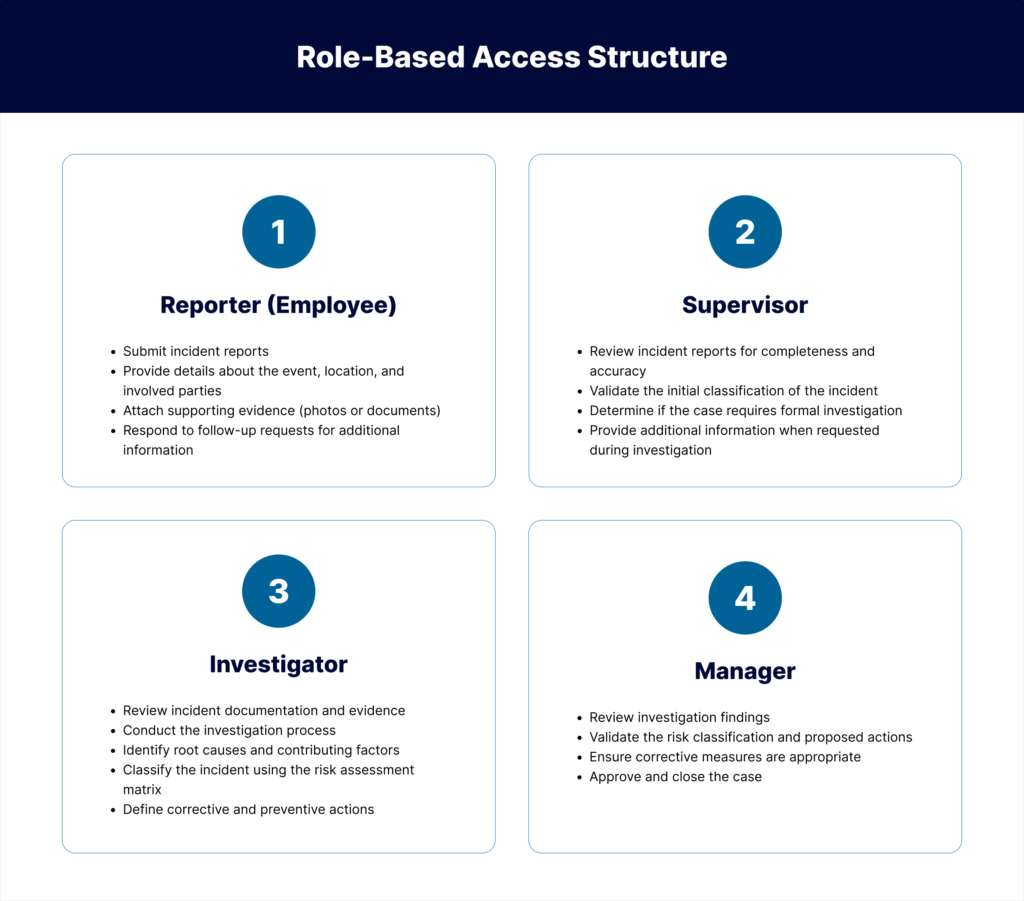
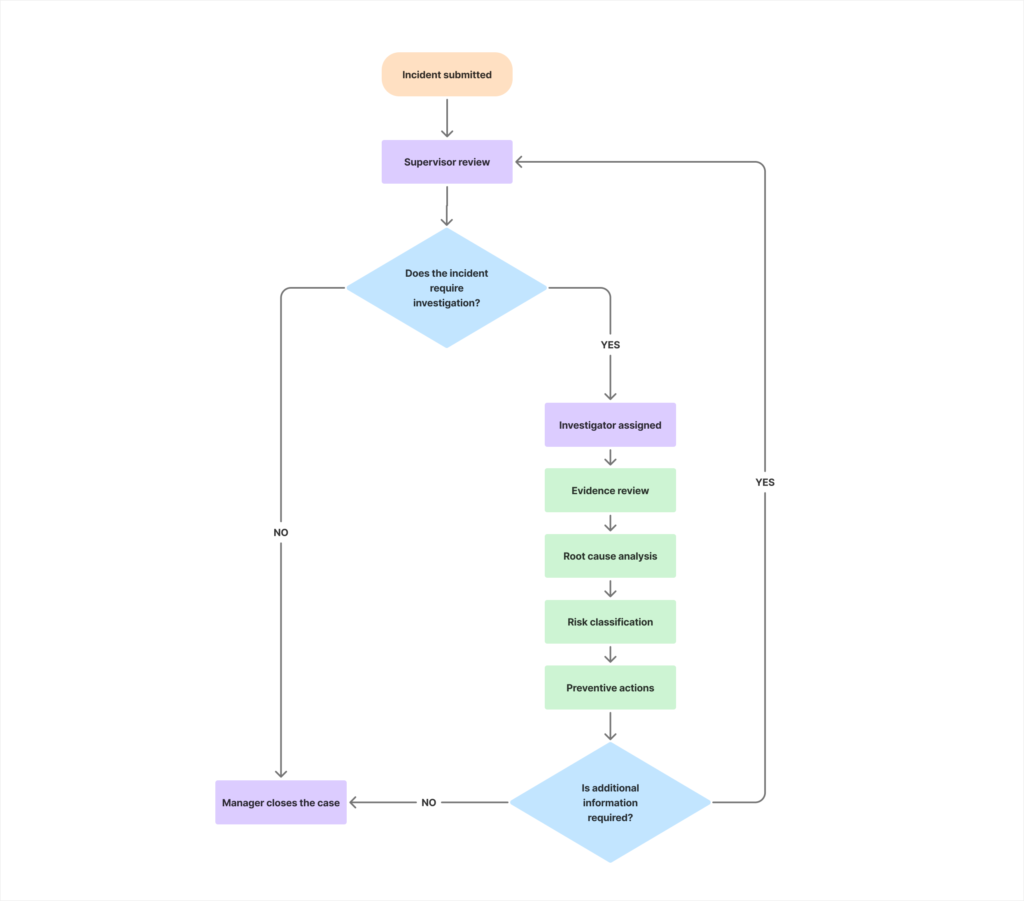
The objective was to transform the reporting experience into a structured, role-driven lifecycle while balancing user clarity with operational governance. Before designing interface components, I mapped the case lifecycle as a series of state transitions across four key roles: Reporter, Supervisor, Investigator, and Manager. The solution introduced a controlled progression of stages:

1. Incident Submission

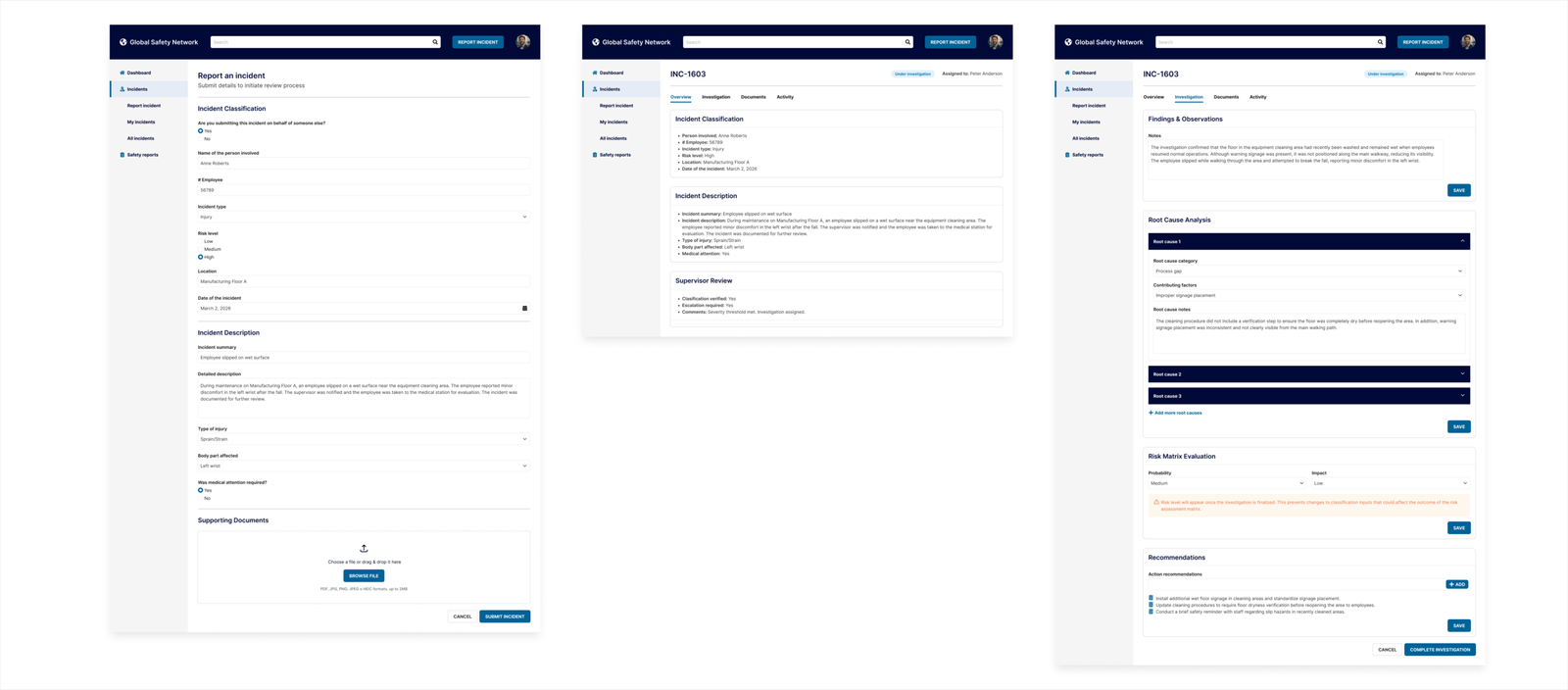
The original form was restructured into clear, logical sections to improve usability and data quality. The redesigned intake experience:
  • Grouped related inputs into structured sections
  • Introduced standardized categorization (incident type, severity indicators)
  • Applied contextual field visibility based on user input
  • Included validation states to reduce incomplete or inconsistent submissions
  • Supported multiple reporting scenarios (self, on behalf of another person)

While classification inputs were captured at this stage, the final risk level was not exposed to users to prevent premature or biased assessment.

2. Supervisor Review & Escalation

Once submitted, the incident transitioned to a supervisor for initial review. At this stage, the supervisor:
  • Validated the completeness and accuracy of the report
  • Reviewed the initial classification inputs
  • Determined whether the incident required formal investigation

Not all incidents required escalation. A decision point introduced controlled branching:
  • Low-impact cases could be documented and closed
  • Higher-risk cases were escalated for investigation

3. Investigation, Risk Assessment & Action Definition

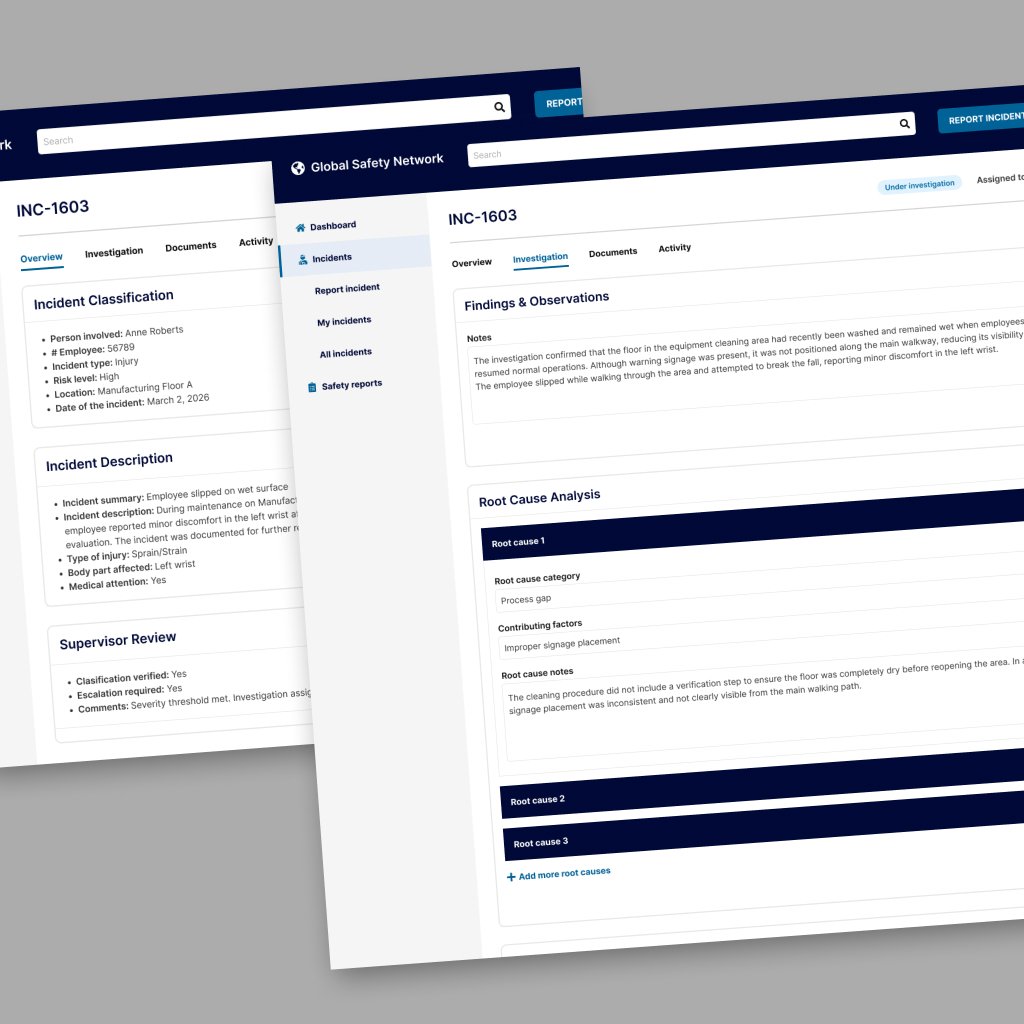
For incidents requiring deeper analysis, an investigator was assigned. The platform centralized the full investigation workflow, enabling the investigator to:
  • Review incident details and supporting evidence
  • Document findings and observations
  • Identify root causes and contributing factors
  • Classify the incident using a risk assessment matrix
  • Define corrective and preventive actions
  • Upload supporting documentation

To ensure objectivity, the system calculated the final risk level only after investigation inputs were completed, preventing manipulation of classification variables. The investigation process remained iterative, allowing cases to return to the supervisor if additional information was required.

4. Resolution & Controlled Closure

Once the investigation was completed, the case moved into final review. At this stage:
  • Findings and risk classification were validated
  • Recommended actions were reviewed
  • Additional information could be requested if needed
  • Closure authority was restricted to the Manager role.
  • Only after approval could the case be formally closed, ensuring accountability and governance within the system.
Instead of adding more features, the focus was on redefining the structure to improve clarity and usability across the platform.

Outcomes

While specific performance metrics remain confidential, the redesigned system:

  • Improved clarity and completeness in incident reporting
  • Enabled structured investigation workflows
  • Increased visibility across case lifecycle stages
  • Centralized documentation and evidence tracking
  • Reduced back-and-forth between roles through clearer ownership
  • Introduced governance and control in case closure.
  • Enabled a more structured and scalable workflow for incident management across teams.

What This Project Demonstrates